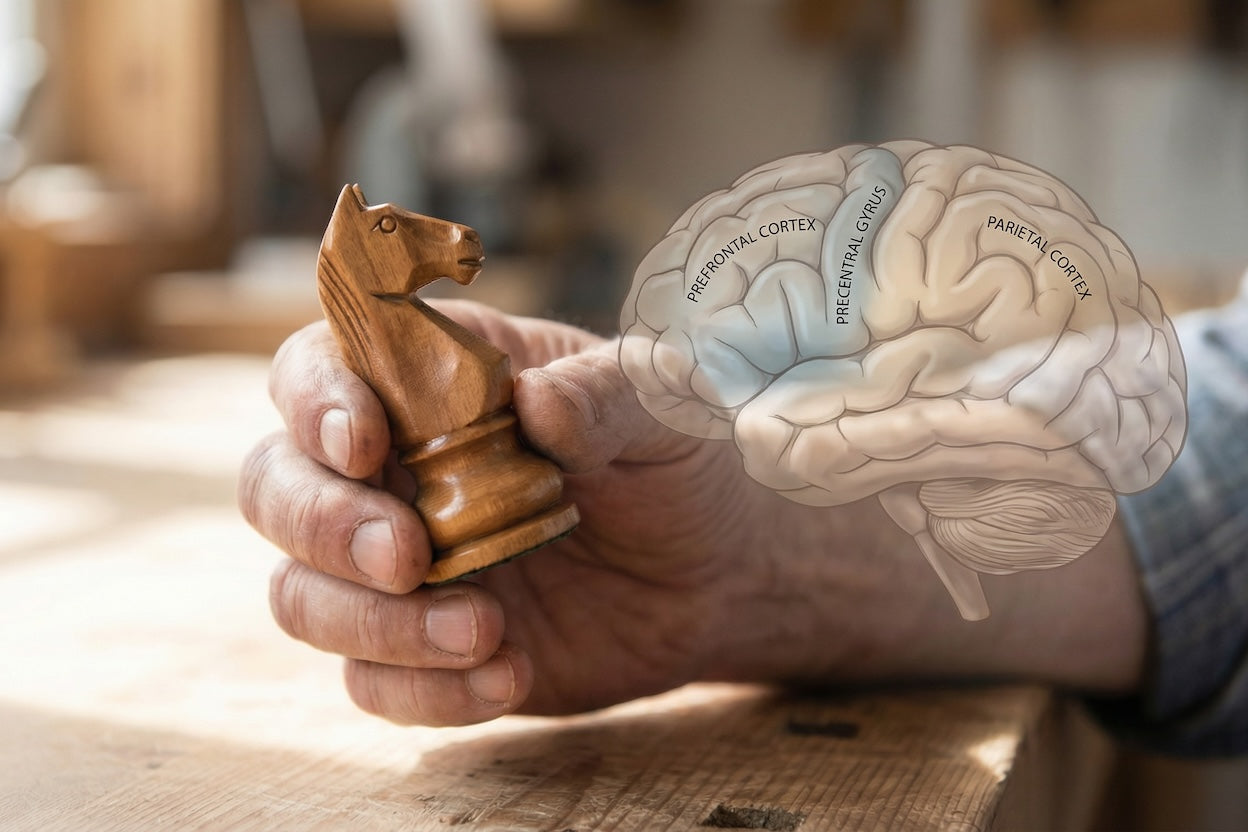
What happens in the brain when we play analog games like chess?
Analog games like chess , board games, and card games require sustained attention, planning, and physical interaction. But what does it actually mean for the brain that the activity takes place without a screen and without constant digital interruptions?
Several areas within cognitive psychology and neuroscience point to the fact that coherent, physically anchored activities activate the brain in a different way than fragmented digital stimulation.
Attention and working memory
Human attention is a limited resource. According to research into so-called “task switching” – described by psychologists David Meyer and Joshua Rubinstein, among others – it costs mental energy every time we switch between tasks. Frequent interruptions increase cognitive load and reduce the efficiency of working memory.
When playing an analog game, the task is typically limited and continuous. The brain can maintain a stable level of attention over a longer period of time, which particularly involves the prefrontal cortex – the area that governs planning, decision-making and impulse control.
Studies of concentration-demanding activities show that longer periods of uninterrupted focus can enhance the ability to maintain complex mental representations. In chess, for example, this means holding multiple possible moves and countermoves in working memory at the same time.
The reward system and dopamine
All meaningful activities activate the brain's reward system, including the release of dopamine in the so-called mesolimbic system. This applies when we play sports, play music – and when we solve a tactical challenge in a game.
The difference lies in the pace and structure of the stimulation.
Digital platforms are often designed to deliver quick, unpredictable rewards, which, according to behavioral psychology research, can increase the urge to repeat. Analog games typically provide more gradual and effort-dependent rewards. Dopamine release is linked to problem-solving and mastery rather than sudden external stimuli.
Mihaly Csikszentmihalyi's research on flow states shows that people experience particular satisfaction when challenge and skill are in balance. This balance is often found in music practice, sports – and in strategic games, where one gradually immerses oneself in a task with clear rules and direct consequences.
The role of the body in thinking
A significant difference between digital and analog activities is the degree of physical interaction.
Research into “embodied cognition” – described by Lawrence Barsalou, among others – shows that cognition is not isolated to the brain, but is closely connected to the body’s movements and sensory impressions. When we handle physical objects, both motor and sensory areas are activated, which can enhance memory and understanding.
A related example is found in studies from Princeton University and UCLA, where Pam Mueller and Daniel Oppenheimer have shown that students who take notes by hand often understand and remember the material better than those who type on a computer. The physical act influences cognitive processing.
When you move a piece on a board, the decision is not only mental; it is also motor and tactile. This anchors the process in the body.
Predictability and mental strain
The brain uses significant resources to orient itself to new stimuli. The so-called orientation response is activated when something unexpected happens. In environments with constantly changing input, this system is often kept active.
Analog games take place in a more stable sensory environment. Stimuli change, but within known frameworks and rules. This can reduce cognitive load and allow for deeper processing.
A related example from the world of chess is the classic Staunton design , which has been the standard in tournament chess since the mid-19th century. The proportions and silhouettes of the pieces are designed with clear recognition in mind. This reduces visual uncertainty and makes it easier to read the position quickly.
Comparison with music and sports
The effect is reminiscent of what you see in music and sports.
When performing music, motor, auditory and prefrontal areas of the brain are activated in a coordinated process. In endurance sports, studies show that repetitive movements and stable rhythm can promote flow states and reduce experienced mental noise.
Analog games share several of these characteristics: clear rules, direct feedback, and a balance between challenge and skill.
A structured mental exercise
Analog games are not passive entertainment. They require planning, risk assessment, memory, and the ability to postpone immediate action.
In a day-to-day life characterized by fragmented attention, such activities can function as structured mental training.
Not as resistance to technology. But as another form of cognitive activation.