How to Get Better at Blitz Chess – The Complete Guide
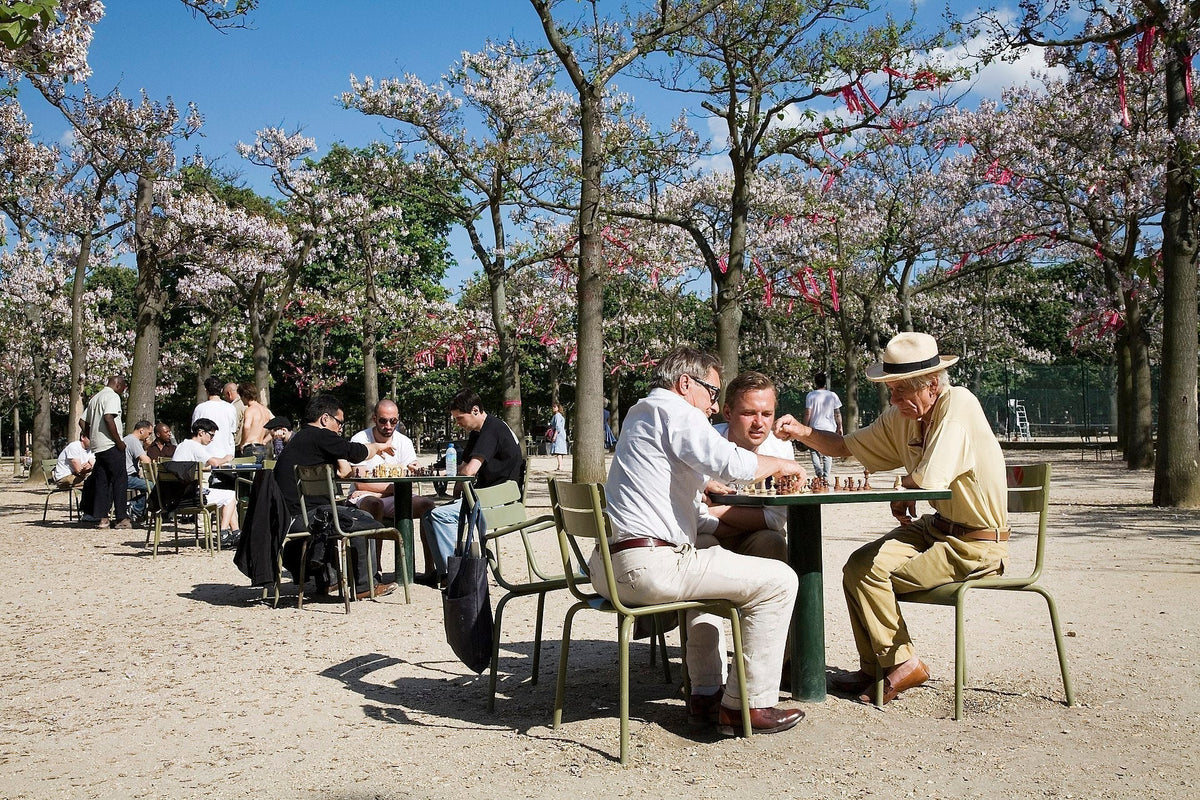
If you have walked through the Luxembourg Gardens in Paris, you may have seen them. A couple of chess tables under the trees. Usually older men, a clock beside the board and a small group of spectators standing with their hands in their pockets. Challengers come and go. The man on one side of the table looks as if he has been sitting there since 1987.
Maybe you stood and watched for a while. Maybe you considered sitting down.
And maybe it was just as well that you did not.
Because a player who has played thousands of blitz games at a table like that is not just a friendly pensioner with a chessboard. He recognises the positions before you have seen them. He plays quickly without rushing. He knows when to stop and think, and he knows how to give an opponent problems while the clock is running. It looks like improvisation. It is not.
This guide has two aims. The first is to make you concretely better at blitz chess – online, at the club or in the park. The second is less measurable: to give you a little more courage to one day actually sit down in the empty chair.
The guide is long. It is written to be read in sections and returned to. Some parts are for you if you know the rules and play a little online. Others are for you if your rating is well above 1600 and you still want to know why you lose winning positions on time. Skip around freely.
What do you actually need to get better at?
FIDE, the international chess federation, defines a blitz game as a game in which each player has no more than 10 minutes for all their moves – or where the starting time plus 60 times the increment adds up to no more than 10 minutes. The increment is the number of seconds added to the clock after each move. So 3+2 means three minutes plus two seconds per move, and the calculation is 3 minutes + 60 × 2 seconds = 5 minutes. That is blitz chess.
The other terms you will come across:
- Bullet: under roughly three minutes per player. “Bullet” is an internet term, not a category in the FIDE Laws of Chess.
- Blitz: typically 3+0, 3+2, 5+0 or 5+3.
- Rapid: more than 10 and less than 60 minutes. 15+10 is a classic rapid time control.
- Classical: 60 minutes or more per player.
Chess platforms draw the boundaries slightly differently. Chess.com and Lichess, for example, both classify 10+0 as rapid even though under FIDE rules it is formally blitz. In practice, that does not matter much. What matters is the time control you are actually playing.
Playing good chess and producing good chess quickly are two different skills. One is to play good chess: understand positions, calculate variations and choose good moves. The other is to produce good chess quickly and consistently, move after move, while the clock is running.
The two are closely connected, but they are not the same. The American grandmaster Daniel Naroditsky (1995–2025), who for years was among the world's best blitz and bullet players and one of the most popular chess educators online, wrote about exactly this in his article series The Blitz Chess Manifesto on Chess.com. His point was that the gap between blitz and classical chess is smaller than many people think – but the relationship is far from linear. Not every strong tournament player is equally good at blitz, and vice versa. Blitz requires you to look at the game through slightly different lenses.
The research points in the same direction. In 2004, psychologist Bruce Burns studied results from blitz tournaments and found that up to 81 percent of the variation in playing strength could be explained by how players performed with less than five percent of normal thinking time. In other words, a good blitz player is to a large extent simply a good chess player.
But a Dutch study from 2007 (van Harreveld, Wagenmakers and van der Maas) adds an important nuance. The shorter the time control, the less accurately the rating difference predicts the result. As the time disappears, stronger players lose some of their advantage. The authors conclude that the slower part of thinking – calculation and search – is at least as important to strong players as it is to weaker ones.
That is the starting point of this guide. Blitz chess is not a different sport in which bad tricks suddenly become good. Good blitz is built on good chess. But the time limit changes the conditions under which decisions are made, and there are skills you can train specifically.
A strong blitz player does not simply think faster. He or she:
- recognises more positions and patterns without having to calculate them from scratch
- knows which positions actually require calculation
- uses time unevenly and deliberately
- often reaches positions he or she understands and can play quickly
- sets the opponent practical problems
- adjusts play to both the position on the board and the position on the clock
- learns systematically from many fast games
If this guide has to be reduced to one sentence, it is this:
You do not become good at blitz by rushing every move. You become good by being able to play many moves quickly, so that you have time for the few moves that should not be played quickly.
See more, calculate less
An experienced player does not go through every variation ten times faster than a beginner. She sees fewer irrelevant possibilities. The position immediately looks like something she has seen before: a back-rank motif, a fork, an overloaded defender, a typical pawn break, a familiar mating pattern, an elementary endgame. She spends almost no time reinventing the solution.
This is well documented in research. As early as the 1940s, Dutch psychologist and chess master Adriaan de Groot showed that grandmasters often find the right move in their first impression of a position. William Chase and Herbert Simon later explained this by showing that experienced players store recognisable patterns and groups of pieces in long-term memory, and therefore see a position as a small number of meaningful units rather than 25 individual pieces.
There is also brain research on the subject. A Spanish EEG study from 2019 compared chess players' brain activity in rapid chess (15+10) and one-minute games. In the fastest games, the researchers observed a pattern they interpret as increased retrieval of familiar patterns from memory. The study is small (14 players), and the interpretation is cautious. But it fits what most blitz players know from experience: when time disappears, you live on what you already know.
The point is not that intuition replaces calculation. In a 2026 study, Michael Vidulich and Pamela Tsang analysed games by 20 grandmasters and seven world champions. Even the very best players made more serious errors under severe time pressure. What distinguished them was that they were strategic with their time: they played intuitively when it was safe to do so, and thought when it was necessary. That is exactly the skill this guide is about.
Solving a difficult problem and recognising an easy one are two skills that look similar but are trained differently:
- Solving a difficult problem: You have time, the position is complicated, and you have to calculate your way through it.
- Recognising a simple problem instantly: You see the position and the solution is simply there. No calculation, or only a brief check.
Both are necessary. But blitz especially rewards the latter. If you need 20 seconds to find a fork you could have seen in two, you have spent 18 seconds that you will miss later.
 White to move. You have 10 seconds.
Solution: 1.Qd8+! Rxd8 2.Rxd8#. The rook on c8 is the only defender of Black's back rank. The queen forces it away. Black has no alternative: the king can go to neither f8 nor h8 because the queen controls the entire eighth rank.
Why it matters in blitz: The position requires no calculation if you know the pattern. Black king behind three unmoved pawns, one defender of the back rank and two heavy pieces on the d-file. It is one of the most common mating patterns in amateur chess, and it should take a second to see. If you only spot it after calculating, you have not automated it yet.
What should you train? If pattern recognition is the core skill, the training is easy to describe. You need to have seen the typical situations so many times that you no longer have to think about them: tactical motifs, simple mating patterns, elementary endgames, the structures from your own openings – and your own recurring mistakes, because those are the ones you are most likely to meet again.
For tactical training, one simple rule applies: many easy problems solved quickly build recognition. A few difficult problems solved slowly build calculation. You need both, but if you want to improve at blitz, a significant part of your training should consist of problems you can solve in under ten seconds – and repeat until you can.
Time is part of the position
In a blitz game you have two positions: the one on the board and the one on the clock. A position that is winning on the board with four seconds against one minute is not necessarily winning. A slightly worse position with twice as much time may be the better one to have.
Daniel Naroditsky opened his article The Art of Time Management with a joke: many people think time management in blitz is based on three principles. You have to be fast. You have to be fast. And you have to be fast. His point was that of course the aim is to be fast, but telling someone to play faster is useless. The question is not whether to be fast, but how.
His answer was a deliberate philosophy about which decisions deserve time.
Critical moments. Not all moves are equally important. Some moves should almost never cost much time:
- a standard developing move in an opening you know
- a recapture that is forced
- a simple king move after a check
- a move in a plan you have already formed
Other moves deserve time because they determine the direction of the game:
- a possible sacrifice
- an irreversible change in the pawn structure
- a choice between a queen trade and continuing the attack
- a tactical complication
- the transition into an endgame
It may sound obvious. But look at your own games. How many times have you spent 25 seconds on move ten because you were not quite sure whether the knight belonged on d2 or f3, and then played move 30 – the move where the position actually collapsed – in three?
The main principle is:
Play the easy moves quickly enough that you have time for the difficult ones.
How long is “a long time”? Naroditsky carried out an unscientific but instructive experiment. He recorded how long Hikaru Nakamura spent on each move in three of his blitz wins on Chess.com. Across all three games, Nakamura spent ten seconds or more on a move only three times – and those were the moments that decided the game.
On that basis, Naroditsky proposed a rule of thumb: as a starting point, only spend 15 seconds or more on a move if you believe the position is critical. He stressed that it is not a fixed rule. It is a boundary you can hold yourself to. If you have spent a minute on three moves without anything to show for it, it is a sign that you need to tighten up.
The number should be treated with caution. What is right in 3+0 for a 2400 player is not necessarily right in 5+3 for a 1300 player. But the idea works at every level: long thinks should be exceptions, and they should be used where they make a difference.
Slow down when you are winning – and when you are losing. One of Naroditsky's principles runs counter to what most people do. He recommended slowing down in two situations: when you are winning, and when you are losing.
The first part is easy to understand. When the win is close, it is tempting to ride the momentum and play everything too quickly – until you hang your queen or give stalemate. If you have time, spend a few extra seconds checking for traps.
The second part is less obvious. If you are losing, conventional wisdom says to play quickly and try to pressure your opponent on the clock. But if the opponent has plenty of time because you made the mistake early, you are only going to lose faster. Then it is better to concentrate on the position and find the defensive moves and traps that actually have a chance.
Use your opponent's time too. The time your opponent spends thinking is not a break. It is the cheapest thinking time you get in the game.
While your opponent is thinking, you can:
- understand why the last move was played
- guess the likely next move
- find your natural replies to the two or three most likely moves
- judge whether the position is approaching a critical decision
Naroditsky wrote that good old-fashioned anticipation had saved him more often than all his premoves put together. He also explained why anticipation matters more in blitz than in classical chess. In a long game you can take time to regroup after an unexpected move. In blitz, an unexpected move can be fatal because you do not have time to start again from scratch.
Anticipation and premoves are not the same thing. Online there are also premoves. You choose your move while it is your opponent's turn, and the server executes it as soon as the opponent has moved. On Chess.com it costs only 0.1 seconds.
But Chess.com's own help pages are clear: a premove is executed even if the opponent plays something unexpected. It is only cancelled if it has become illegal – for example because you are in check.
So distinguish clearly between two things:
- Anticipation: “If she plays X, I will probably reply Y.” You still have the chance to see what actually happened.
- Premove: “Whatever she plays, the computer executes Y.”
The first is a fundamental chess skill. The second exists only online.
Premoves are safe when the move is practically forced: a recapture where the opponent has no meaningful alternative, or a sequence in a winning endgame where no reply changes anything. They are dangerous in every other type of position. The classic example is premoving a recapture when the opponent instead plays an in-between move – for example attacking your queen. The recapture is still legal, so the server executes it and the queen is lost. If you often lose that way, the answer is not to avoid premoves entirely, but to use them more selectively.
A simple decision system
Classic chess books often give long checklists for every move. You do not have time for that in blitz. But you do have time for five short questions, and most of them take a second once they have become a habit:
- What did my opponent's last move change? Which squares does the piece attack now? What has it stopped defending?
- Is there a concrete threat or tactic? For either side.
- Do I have a natural move? A move that fits the plan and does not require calculation.
- Is the position critical? Then calculate. Otherwise play the natural move.
- Before you release the piece: What is my opponent's strongest reply?
The fifth question is the most important and the one most often skipped. Many serious blunders in blitz happen not because the player could not see the problem, but because the player did not look.
Checks, captures and threats – as a search method. In tactical positions it is useful to look at forcing moves first: checks, captures and threats. It is a quick and systematic way to find moves that can change the position in a single move – both yours and your opponent's.
But it is a search method, not a rule for choosing moves. A check is not better than a quiet improving move just because it is a check. Often the opposite is true: a pointless check drives the king where it wants to go and wastes a tempo. The aim is to make sure you do not miss something forcing, not to play it automatically.
 Black has just captured your queen on d1. White to move. You have 8 seconds.
Most players automatically recapture with one of the rooks. It is a perfectly good move – afterwards you are a rook up.
Solution: 1.Rxe8#. The black king cannot escape the back rank, and the queen on d1 can neither capture on e8 nor interpose on f8.
Why it matters in blitz: the recapture feels forced, and those are exactly the moves people premove or play by reflex. Question 2 – is there a concrete tactic? – takes one second and turns a good position into checkmate. Notice, by the way, that the king is on g2. If it were on g1, the rook on e1 would be pinned by the queen on d1 and Rxe8 would be illegal. Details matter, even when you are in a hurry.
When the system becomes automatic. The aim is not to sit there reciting five questions. The aim is for the questions to become part of the way you see the board. That only happens through repetition. A good place to start is to choose one question – usually the first or the fifth – and focus on it for an entire training session.
Openings and simple plans
There is no list of “the five best blitz openings” that applies to everyone. What works is a personal repertoire with the right characteristics. A good blitz repertoire:
- often leads to structures you know
- has plans you understand
- lets you play a large part of the opening without using much time
- contains tactical motifs you have seen many times
- is not so broad that all your training becomes superficial
- does not necessarily give your opponent 15 free moves from memory
The last point is worth thinking about. If you play the most theoretical main line, there is a good chance your opponent has seen it just as many times as you have. You both spend two seconds on the first fifteen moves, and the game only really begins after that.
An example from a specialist. American grandmaster Maxim Dlugy, whom Chess.com presents as one of the world's best blitz players, made an instructional series for Chess.com called Best Blitz Openings. He covered, among other things, the London System, the Vienna Game, the Sicilian with 3.Bb5, the Leningrad Dutch and Alekhine's Defence.
The reasons are practical, not theoretical. The London is described as solid and flexible. The Vienna as a quick route to a good, playable position. On the Leningrad Dutch, the series itself notes that some consider it positionally dubious – but that it works as a weapon in blitz.
Use the list as an illustration, not as an answer sheet. The right repertoire for you is the one you understand and enjoy playing.
Know the ideas, not just the moves. If your repertoire ends the moment your opponent plays a move that was not in the video, you have not learned the opening. You have learned a sequence of moves.
For every opening you play, you should know:
- the natural squares for your pieces
- the typical pawn breaks
- which pieces are usually good and which are bad
- which exchanges you want
- which endgames the structure typically leads to
That makes you faster even when your opponent leaves theory. You do not need to remember the next move. You need to know where the pieces belong.
A practical test: take a position from your opening after 12–15 moves. Can you say within ten seconds what the plan is for both sides? If not, that is the part of the repertoire you need to work on – not move 16 of the main line.
Simple plans are fast plans. A simple plan is one of the most underrated time-saving tools in blitz. If you know what you are trying to achieve, the next decisions become easier and faster.
Imagine two ways of playing a middlegame. In the first, you start from scratch on every move. In the second, you have decided:
I want to control the c-file, exchange my bad bishop and then attack the isolated pawn.
Several of the next moves almost explain themselves. The rook goes to c1. The bishop heads for the square where it can be exchanged. The knight finds a route towards the isolated pawn. You still need to check for tactics on every move – questions 2 and 5 from the decision system – but you do not have to reinvent the position.
This is the bridge between ordinary positional chess and time management. A plan is not only a strategic idea. It is also a way of saving time.
A plan must of course be abandoned when necessary. If your opponent suddenly attacks on the kingside, that is not the moment to cling to the c-file. But that is precisely a critical moment: the position has changed character, and now you should use time.
Make the game easy for yourself and difficult for your opponent. Imagine two moves that are roughly equally good.
Move A gives your opponent one obvious reply. She plays it in a second, and the position is clear.
Move B leaves three or four reasonable options with different plans and a couple of tactical details that have to be checked.
In a classical game the difference is small. Your opponent has time to find the right answer. In blitz, B can have considerable practical value because it costs her time – and because every extra decision is another chance for a mistake.
But there is an important condition: B must also be a good chess move.
This is where many blitz guides go wrong. They recommend traps and tricks that work against weak opponents but are objectively bad. That is not practical chess. It is simply bad chess with an excuse.
A better formulation:
When several moves are objectively acceptable, the best practical choice in blitz may be the one you understand well, can follow up quickly, and that forces your opponent to solve more problems.
Practical ways to do that:
- Keep the tension if it creates choices. An exchange often solves your opponent's problems for her. Do not exchange without a reason.
- Create small, concrete threats. A threat demands a response. It costs time even if the response is easy.
- Avoid simplifying when the position is equal and your opponent has less time. Complex positions are most expensive for the player with the least time.
- Choose structures you know and your opponent may not. That is the whole point of a personal repertoire.
It is not manipulation. It is part of chess. Strong players have always chosen between equally good moves based on which positions their opponent is least comfortable in.
When you are better. A surprisingly large number of blitz games are lost from clearly winning positions. The reason is rarely that the player did not know how to win. The reason is that he was looking for the wrong thing: mate, a beautiful combination, more material or “the most precise” move. Often the most important thing is something else entirely: removing your opponent's counterplay.
Principles:
- Exchange your opponent's active pieces. Not every piece – the ones creating problems for you.
- A queen trade is often attractive when you are materially ahead. Without queens, most perpetual checks and sudden mating attacks disappear.
- Reduce tactical chaos. A position with fewer loose pieces is easier to play quickly.
- Be careful about automatically exchanging everything. A drawn pawn endgame, or the wrong-coloured bishop with a rook pawn, can throw away a winning position.
The aim is not to push the engine evaluation as high as possible. It is:
Keep a clearly winning position that is easy to play.
 White is a rook up. The black queen on b2 attacks a2 and f2. White to move. You have 15 seconds.
Solution: 1.Qe5+! The queen is on the same diagonal as both the black king and the black queen.
- If Black captures with 1...Qxe5, 2.Rxe5 follows, and White is a clean rook up with the queens off the board.
- If Black moves the king (Kg8, Kf8 or Kh6), White takes the queen on b2 (a skewer).
- 1...f6 blocks the check, but White still takes the queen on b2 – and at the same time escapes the attack from the f-pawn.
Why it matters in blitz: there are other moves that also preserve the advantage. But 1.Qe5+ removes the entire problem that could make the game difficult: the black queen's ability to pick off pawns and give checks. What remains is an endgame with an extra rook that can be played at two seconds per move.
When you are worse. The logic often reverses. If a quiet, simplified sequence leads to a trivial loss, it is usually better to keep pieces on the board, create imbalance, open lines towards the enemy king, make concrete threats – and avoid voluntary exchanges that make the win mechanical.
No romanticising hopeless sacrifices, though. A sacrifice that threatens nothing merely gives your opponent an easier game. Good practical defence is still chess: find the moves that actually create problems.
And remember Naroditsky's point from the time-management section: if your opponent has plenty of time, you gain nothing by playing quickly. It is better to use your time to find the best defensive moves.
 White is two rooks down. White to move. You have 10 seconds.
Solution: 1.Qg6+! Kh8 2.Qh6+ Kg8 3.Qg6+ and perpetual check. After 1.Qg6+, Kh8 is the only legal move: f7, g7 and h7 are covered by the queen, f8 is occupied by Black's own rook, and no black piece can interpose on g7. After 2.Qh6+, Kg8 is the only move. Black cannot escape the loop.
Why it matters in blitz: players who are losing often stop looking for checks. Perpetual check is one of the most common saving patterns in blitz, and a king without a pawn shield is the signal you should react to.
When should you resign? As a rule, you should resign later in blitz than in classical chess. Not because etiquette does not matter, but because time, tactical mistakes and stalemate possibilities can change a position that would otherwise be lost.
A simple rule of thumb: if your opponent has plenty of time and the position is trivially winning – queen against nothing, for example – there is no reason to play on. If your opponent has only a few seconds, or if the win still requires technique, it is entirely legitimate to make her prove it.
60 seconds, 30 seconds, 10 seconds
Your strategy has to change as your time disappears. It sounds obvious, but many players do the opposite: they keep playing as if they had three minutes until they suddenly have five seconds and panic.
The numbers below are guidelines. The point is not the exact numbers, but that your behaviour should change in stages.
With about one minute
You can still play relatively normal chess. But long calculations become dangerous. A single 20-second think costs a third of your remaining time.
- Play by plans and patterns. Save calculation for positions where there is a concrete tactical decision.
- Start steering towards positions you can play quickly.
- Check your opponent's clock. If she has less time than you, a complex position is your friend. If she has more, a simple position is your friend.
With about 30 seconds
It becomes increasingly important to find good moves that are also easy to follow up quickly.
- Avoid lines where every move requires fresh calculation unless it is necessary.
- Prefer moves that reduce your opponent's options: exchanges when you are better, safe king positions, locked structures.
- Use your opponent's time actively. If you know what you will reply to her likely moves, you can save several seconds per move.
With about 10 seconds
Here the time control matters enormously.
With increment you can stabilise. If you play every move in under two seconds in 3+2, your time stays constant or increases. You can “live off” the increment. That requires safe, simple moves – and no panic.
Without increment you depend on being able to play the position almost entirely by recognition. Choose moves that do not require difficult follow-ups: avoid positions where your opponent has many checks and where one missed capture ruins everything.
Be very careful not to treat 3+0 and 3+2 as the same game. A two-second increment radically changes the end of a game. In 3+2, ten seconds can be many moves. In 3+0, ten seconds can be almost nothing.
When you are winning with only seconds left
One of the most frustrating ways to throw away a winning position in time trouble is not to lose on time. It is to stalemate your opponent.
 White to move. You have 5 seconds. Which moves are checkmate – and which are stalemate?
Solution: 1.Qh5# and 1.Qh2# are both checkmate. The white king on f7 covers g8 and g7, so the black king has only h7 as an escape square. Both moves give check on the h-file while also taking away h7.
But 1.Qe4, 1.Qd3 and 1.Qc2 – moves that look as though they “box the king in” by covering h7 along the diagonal – are all stalemate. Black has no legal moves and is not in check.
Why it matters in blitz: with only a few seconds left, many players make the move that “feels right”: take away the final escape square. Here that is the wrong move. The simple rule is: when your opponent has only the king left, check whether he still has a legal move after your move. It takes one second.
3+0, 3+2, 5+0, 5+3
The four most common blitz time controls reward slightly different behaviour. It is not a mathematical formula; it is a question of what the clock rewards.
| Time control | What the clock rewards | What you should do differently |
|---|---|---|
| 3+0 | Speed and simple positions. Time is a scarce resource and does not come back. | Play the opening quickly. Avoid long thinks in the middlegame. Expect endgames to be decided by the clock. |
| 3+2 | Endgame technique. It becomes harder to win on time alone. | You can recover from only a few seconds by playing safe moves. Elementary endgame knowledge pays off. |
| 5+0 | Room for a few deeper decisions. | You can spend 30–40 seconds on a truly critical move. But perfectionism across many moves is still punished heavily. |
| 5+3 | Closer to “real” chess in the endgame. | Correct technique matters more than raw speed. A technical advantage should often be converted on the board. |
In 3+0, a player with twice as much time as the opponent can often win an equal position simply by playing quickly and safely. In 5+3 this works less often because the increment gives the opponent time to stabilise.
If you want to improve at blitz, rather than merely win as many games as possible today, there is a good argument for training with increment. Increment forces you to play chess in the endgame rather than win on the clock. That is where you learn the most. The FIDE World Blitz Championship, incidentally, is played at 3+2.
Tactics – but useful tactics
Blitz is not only about tactics. But tactics matter a great deal because many games are decided there, and because tactical patterns are among the easiest things to automate.
The diagrams below were chosen because they train recognition rather than calculation. Try to solve them within the stated time. If you cannot, that is not a failure. It is a problem you should see again in a week. Every example in this guide was constructed for the purpose.
 White to move. You have 5 seconds.
Solution: 1.Ne7+ and 2.Nxc6. The knight gives check and attacks the queen at the same time. A knight check cannot be blocked, so Black has to move the king.
Why it matters in blitz: knight forks are among the easiest patterns to miss in fast play because a knight does not move along lines. Train yourself to see squares from which a knight attacks the king and queen at the same time.
 White to move. You have 8 seconds.
Solution: 1.Rh6+! Check along the sixth rank. The king is in front, the queen behind it on a6. The king has to leave the rank – c6 and e6 are still in check – and then the rook takes the queen. Black cannot interpose because the queen cannot reach any of the squares between the rook and king.
Why it matters in blitz: a skewer is the mirror image of a pin. The more valuable piece is in front and has to move. King and queen on the same rank, file or diagonal is a pattern you should react to immediately – both when they are your opponent's pieces and when they are your own.
 Black's queen attacks your bishop on e4. White to move. You have 8 seconds.
Solution: 1.Bxb7+ (discovered check). The bishop captures the queen while the rook on e1 gives check at the same time. 1.Bc6+ also wins the queen: it is double check from bishop and rook, so Black has to move the king, and after 1...Kf8, 2.Re8 is even checkmate.
Why it matters in blitz: the natural response to an attack is to move the attacked piece to safety. But when that piece stands in front of a rook or queen on an open line, ask whether it can move with gain.
 Your queen on h5 is attacked by the knight on f6. White to move. You have 15 seconds.
Solution: 1.Bxf6! Remove the defender. The knight on f6 attacked the queen and was also the only piece apart from the king defending h7. White now threatens 2.Qxh7#: the king cannot capture the queen because the bishop on d3 covers h7.
- 1...gxf6 2.Qxh7#
- Most other replies, for example 1...Nd5, also lose to 2.Qxh7#.
- Black can try 1...g6 or 1...h6 to stop the immediate mate. White has won a knight in any case.
Why it matters in blitz: the natural reaction is to move the queen because it is under attack. But instead of defending, you can often capture the attacking piece. The queen-and-bishop battery against h7 is one of the most common attacking patterns against a castled king – and the knight on f6 is the classic defender.
 White to move. You have 10 seconds.
Solution: 1.Qg8+! Rxg8 2.Nf7#. Smothered mate. The king cannot capture the queen because the knight on h6 covers g8, so the rook has to capture. The king is then surrounded by its own pieces.
Why it matters in blitz: smothered mate is rare, but it is built on a very common position: a castled king that has moved into the corner to avoid checks, and a rook beside it. The picture – king on h8, rook on f8, pawns on g7 and h7, a knight able to reach f7 – is something you should recognise immediately.
The same applies to the other side of the board. Most of the patterns above can be prevented with a single move: an escape square for the king, a defended piece, a king moving away from an open line. In blitz, that is rarely a wasted tempo.
Endgames you do not have time to calculate
In classical chess you can spend ten minutes working out whether a pawn ending is won. In blitz you have ten seconds. That is why elementary endgame knowledge is worth more in blitz than almost anything else. It saves thinking.
If you know whether an endgame is won, you do not have to discover it with 17 seconds left.
That is why the positions below are included. Not so that you can explain them, but so that you can play them without thinking. The aim is automation: you should know the position so well that you do not reinvent the solution with 20 seconds left.
| Level | Endgames you should know in your sleep |
|---|---|
| Beginner | Mate with a queen. Mate with a rook. King and pawn versus king. The rule of the square. |
| Intermediate | Opposition and key squares. Pawn races. The active king. Basic rook endgames. |
| Advanced | Lucena and Philidor. Typical fortresses and theoretical draws, such as the wrong-coloured bishop with a rook pawn. |
The quick mate. Naroditsky included a principle he almost thought was too obvious to mention: optimise your basic mating technique. There are many ways to mate with a queen or rook, and some are far quicker and safer than others. He wrote that he only properly learned the fastest method for mating with a rook after he had become a grandmaster.
His recommendation is boring, but it works: play a few games against a computer or a friend where you practise only the elementary mates against the clock.
King and pawn versus king
 White to move. Is the position won?
Solution: yes – and it would also be won with Black to move. A king on the sixth rank in front of its pawn always wins, except with a rook pawn. For example 1.Ke6 Ke8 2.d6 Kd8 3.d7 Kc7 4.Ke7, and the pawn promotes.
Why it matters in blitz: it is the rule, not the calculation, that makes you fast. If you know it, you immediately know whether you can trade down into a pawn ending.
 White to move. Is the position won? What if Black is to move?
Solution: with White to move it is a draw because Black has the opposition: the kings face each other with one square in between, and the player who has to move must give way. With Black to move, White wins because the black king has to step aside and the white king reaches one of the key squares c6, d6 or e6.
Why it matters in blitz: key squares make the concept usable under time pressure. For a pawn on the fourth rank, the key squares are the three squares two ranks in front of the pawn. Once your king reaches one of them, the endgame is won. You do not need to calculate. You need to count squares.
 White to move. Can the black king catch the pawn?
Solution: no. After 1.a5, the pawn's square is a5–d5–d8–a8. The black king on f4 cannot enter the square on its next move, so the pawn promotes, for example 1...Ke5 2.a6 Kd6 3.a7 Kc7 4.a8Q.
Why it matters in blitz: the rule of the square replaces move-by-move calculation with one glance. If the king can enter the square when it is to move, it catches the pawn. If not, it does not. Remember that a pawn on its starting rank can move two squares, so the square is counted from the third rank.
Lucena and Philidor
The two most important positions in rook endgames. One shows how to win. The other shows how to draw. Both are methods that you can either execute in ten seconds – or fail to execute in a minute.
 White to move. How does White win?
Solution: by “building a bridge”. 1.Rd1+ Ke7 2.Rd4! Ra1 3.Kc7 Rc1+ 4.Kb6 Rb1+ 5.Kc6 Rc1+ 6.Kb5 Rb1+ 7.Rb4. The rook on the fourth rank blocks the checks and the pawn promotes.
Why it matters in blitz: without the method, you can spend a minute checking back and forth and end up losing on time. With the method, every move is known in advance.
 Black to move. How does Black hold the draw?
Solution: Black keeps the rook on the sixth rank – here a6, b6 or c6 – so that the white king cannot advance. When White plays e6 to give the king shelter, the rook drops down the file and checks from behind as soon as the king moves forward. The pawn is now in front of the king and no longer provides shelter.
Why it matters in blitz: Philidor is one of the most common drawing techniques in rook endgames. If you know it, you can save many half-points in 3+2 and 5+3, where the increment gives enough time to defend correctly – but only if you do not have to discover the method along the way.
Psychology
Blitz is not only a test of chess. It is a test of how you handle losing, stress and being in a hurry. Most of the problems are familiar, and most of the solutions are simple. The hard part is using them.
Tilt. One loss becomes three because the next game starts three seconds later. Online it is especially easy: the button for a new game is right there.
The solution is a fixed rule that you decide in advance. For example: after two losses in a row, I take a five-minute break. Or: after three losses in a row, I stop for the day. The rule has to be decided before you need it, because you do not make good decisions while you are angry.
Revenge chess. You immediately want to win the rating points back. It is a form of tilt with a concrete objective, which makes it even more damaging. The games become faster, more aggressive and less thoughtful. You are not winning the rating back. You are simply losing more.
Contagious speed. Your opponent moves instantly, and you start doing the same even when the position requires thought. It is a natural reaction, but it is your opponent's pace, not the position's demand.
Remember: if your opponent is playing quickly, you have more time than she does. That is an advantage you can use. Do not let her pace determine yours.
Panic after a mistake. You hang a pawn or a piece and then spend half a minute trying to “fix” the mistake immediately. Often you find nothing, and now you have lost both material and time.
The most important principle:
A mistake creates a new position. Play the new position.
The position you had one move ago no longer exists. The question is not how to get the lost material back. The question is what the best move is now. It may be to put your opponent under pressure. It may be to stabilise. But it is a new decision, not a repair job.
Your surroundings. Naroditsky wrote that high-quality blitz requires good conditions: a stable internet connection, a place without distractions and a reasonably calm mind. He described playing blitz in cafés, lecture halls and airports, while eating or talking on the phone – and said it never worked. He showed two of his own games, one played in a noisy student lounge with an unstable connection, the other in a quiet library. It was hard to believe they had been played by the same person.
If you are particularly stressed or irritated one day, his advice was to skip blitz. It is harder to play well and resist tilt when your emotions are already running high. Five games played with full concentration are worth more than 30 played on your phone on the bus.
How to actually train blitz chess
The most common advice is to solve puzzles and play lots of games. It is not wrong, but it is not enough. Many players have played 10,000 blitz games without improving for years. They have made the same mistakes 10,000 times.
The difference is whether you learn from the games. That requires a simple workflow:
Play → find the critical moment → analyse it yourself → check with an engine → identify the pattern → train it → play again.
The most important step is the third: analyse the position yourself before you turn on the engine. If you go straight to the computer, you learn the computer's answer. You do not learn why you chose the wrong move. And it is your own decision-making error that will appear again in the next game.
A 45–60 minute training session
- 5–10 minutes: tactical warm-up. Easy puzzles, quickly. The aim is to get your eyes working, not to be challenged.
- Play 4–6 focused games at 5+3 or 3+2. The increment gives you games that are decided on the board and are worth analysing.
- After the session: find the first truly critical moment in each game. Not every mistake. The first place where the game took a decisive turn.
- Analyse it without an engine. What were you thinking? What did you miss? How much time did you have?
- Then use an engine. Was your analysis right? What did you overlook?
- Classify the mistake: tactics, opening, time management, positional understanding, endgame or a simple oversight.
- Take one lesson into the next session. One. Not five.
If you want to be slightly more systematic, keep a simple error log: date, time control, type of mistake and one sentence about what happened. After a month you will see patterns. Maybe you lose half your games on time despite being better. Maybe you always miss knight forks. That is where your training should go. It should not feel like schoolwork – but five minutes of reflection after a training session is worth more than five extra games.
Use your own clock as data. Both Chess.com and Lichess store how much time was left after every move. It is an underrated source of information. Look at three or four of your games and ask:
- Where did I spend the most time? Were those the critical moments?
- How much time did I use in the opening?
- How many of my mistakes were played in under two seconds?
The answers tell you more about your time management than any guide.
Training by level
The rating ranges below are guidelines, not scientific boundaries. They roughly correspond to online blitz ratings.
If you are a beginner
The biggest gain is to stop hanging pieces, get your pieces out and your king safe, learn the basic tactical patterns and simple mates. Do not spend months on deep opening theory, exotic gambits or subtle endgames. Those are not what decide your games.
About 800–1200
- tactical awareness, especially your opponent's threats
- questions 1 and 5 from the decision system
- a small repertoire you know well
- simple endgames
- having enough time for critical positions
About 1200–1600
- pattern recognition
- positional plans and pawn structures from your openings
- critical moments
- consistent post-game analysis
In this range, time management starts to matter more. Many players have enough chess skill for the next level but lose games on the clock.
About 1600–2000
- repertoire depth: know your structures better than your variations
- practical decisions: the difficult choices between equally good moves
- Lucena, Philidor and typical rook endgames
- your own recurring mistakes
Over 2000
At this level, general advice is less useful. You probably know most of what is in this guide. What separates players is individual: specific gaps in the repertoire, your own time profile, particular structures you struggle with, and tactical accuracy under pressure.
The best training is often to find the 10–20 games you lost from a good position and see what keeps recurring.
Online and over the board
Chess.com and Lichess are excellent for blitz. You can find an opponent in seconds, play hundreds of games, track your rating, analyse with a strong engine and train puzzles. Most of the training described in this guide is easiest to do online.
But if you have only played blitz on a screen, you should try it over a physical board. It is a different experience:
- You have to move the pieces by hand and press the clock with the same hand.
- The board is three-dimensional and looks different from a screen. Diagonals are harder to see at first.
- There are no premoves. Anticipation is all you have.
- Your opponent is sitting in front of you. You see her reactions, and she sees yours.
- Time trouble becomes physical. You feel it in your hands.
And it is simply fun.
Our completely unbiased recommendation is, naturally, that you do it on a Norwald board.

Two rules you should know
Press the clock with the hand you use to move. The FIDE Laws of Chess require it.
Illegal moves have consequences. Online you cannot make an illegal move. Over the board you can, and in time trouble it happens. Under the current FIDE rules, the following applies in blitz:
- An illegal move is completed when the player presses the clock.
- For the first completed illegal move, the position is restored to the position before the move and the opponent receives one extra minute.
- For the second completed illegal move by the same player, that player loses the game – unless the opponent cannot checkmate by any sequence of legal moves. In that case the game is drawn.
In practice, that means an illegal move in time trouble can cost you both time and – the second time – the game. Better to play a legal move half a second slower. In tournaments where an arbiter is not watching every game, the penalty only takes effect if the arbiter sees it or if the opponent claims it before making her own move. Otherwise the move stands.
25 rules for better blitz chess
If you have read the whole guide, it can be reduced to these sentences. If you have not, they can serve as an entry point.
On time
- Play the easy moves quickly so that you have time for the difficult ones.
- Use time when the position changes character – not when you are unsure about a developing move.
- Use your opponent's thinking time. It is free.
- Anticipation is a chess skill. Premoves are a tool that exists only online. Do not confuse the two.
- Do not let your opponent's pace determine yours.
- With increment, five seconds can be an entire position. Without increment, they can be almost nothing.
- Slow down when you are winning. That is when stalemate happens.
On seeing
- Ask what your opponent's last move changed before looking for your own.
- Before you release the piece: what is your opponent's strongest reply?
- Checks, captures and threats are a search method, not a rule for choosing moves.
- A recapture that feels forced is exactly the move you should check.
- Many easy problems build recognition. A few difficult problems build calculation. You need both.
On plans and openings
- Know your structures better than your variations.
- A simple plan saves time on every one of the next moves.
- A move you understand is often more valuable in practice than a computer line you do not understand.
- When several moves are good, choose the one that gives your opponent the most problems.
- Bad traps are not practical chess. They are simply bad chess.
On advantages and disadvantages
- When you are clearly ahead, make the position easier.
- When you are losing, give your opponent problems – real problems.
- When your opponent's king lacks a pawn shield, look for perpetual check.
- Resign later in blitz than in classical chess.
On learning
- Know elementary endgames so well that you do not have to reinvent them.
- A mistake has happened. Play the new position.
- Decide your tilt rule before you need it.
- Do not just play more blitz. Learn from the blitz you play.
Back to the park
You never finish learning blitz chess. As you get better, the problems move. You become faster at the things that once cost you time, and discover new decisions that do. That is what makes it fun to keep going.
We hope the guide has made you a little better – or at least given you some concrete things to work on in your next game.
The guide is not finished. If you have advice, experience or corrections, write to us. It gets better because of it.
And the next time you walk through the Luxembourg Gardens, or another park where people are playing, and you see the empty chair on the other side of the board:
Sit down.
You may lose.
But now you know a little more about what you are getting into.
Sources and further reading
- FIDE Handbook: Laws of Chess – Article 6.2.3 (same hand), Article 7.5 (illegal moves), Appendix A (rapid chess) and Appendix B (blitz chess)
- Daniel Naroditsky: The Blitz Chess Manifesto, Chess.com, 2018
- Daniel Naroditsky: The Art of Time Management, Chess.com, updated 2019
- FIDE: Daniel Naroditsky (1995–2025)
- Chess.com Help: What are pre-moves and how do they work?
- Chess.com: Best Blitz Openings (Maxim Dlugy)
- van Harreveld, Wagenmakers & van der Maas (2007): The effects of time pressure on chess skill, Psychological Research 71, 591–597
- Burns (2004): The Effects of Speed on Skilled Chess Performance, Psychological Science 15, 442–447
- Vidulich & Tsang (2026): Intuition and deliberation in elite expertise, Cognitive Research: Principles and Implications
- Spanish EEG study (2019): Electroencephalographic response of chess players in decision-making processes under time pressure, Physiology & Behavior 198