The Lewis Chessmen: The Most Mysterious Chess Set in the World
In 1831, a man followed his cow down to the beach at Uig Bay on the Isle of Lewis in the Outer Hebrides, Scotland. The cow had wandered onto the sand. As the man went after it, he spotted something in the dunes: a small stone cist, half-buried.
He opened it.
Inside lay 93 figures – carved from walrus ivory and whale teeth – depicting kings, queens, bishops, knights, and warders. The faces were so lifelike and expressive that, according to local lore, the man believed he was facing elves or spirits and fled in panic.
Since then, they have not left the world.
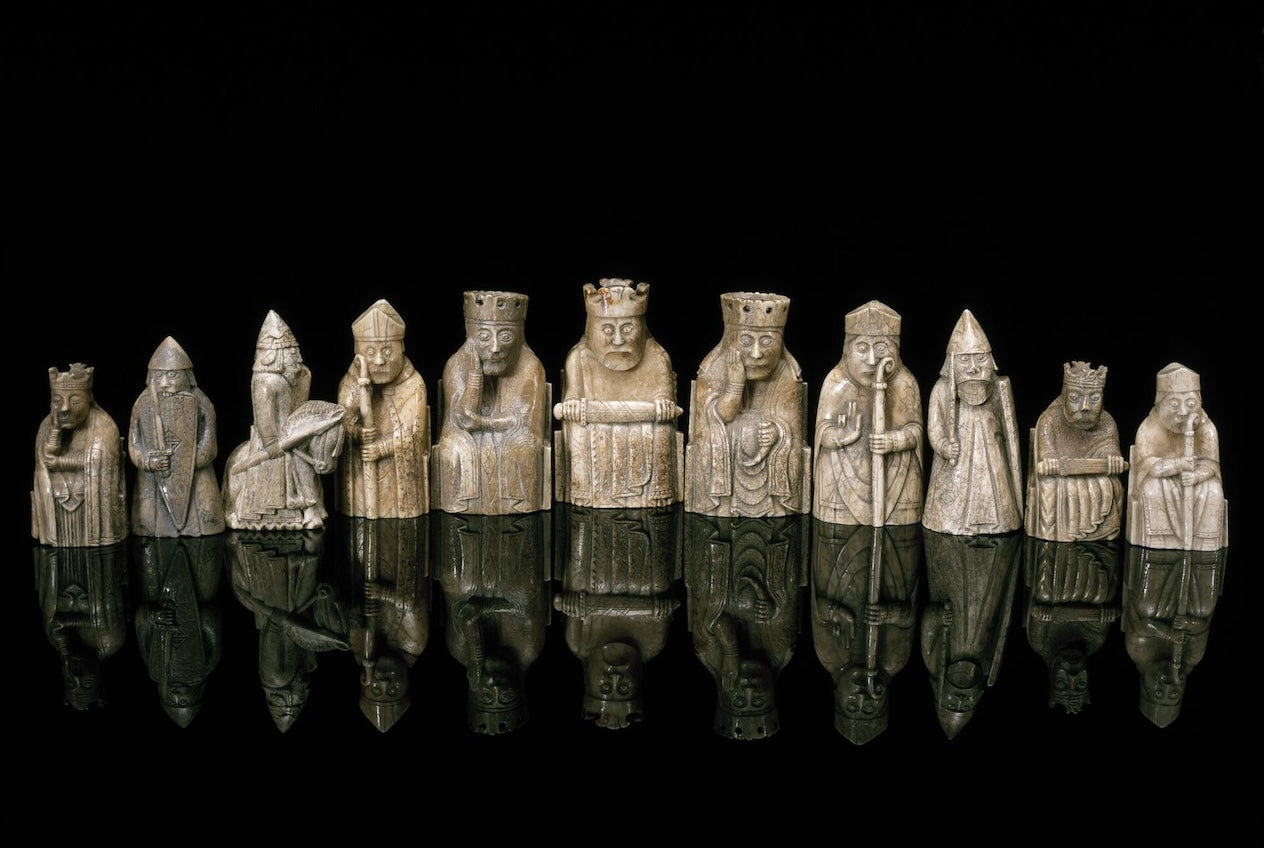
Top photo: The Lewis Chessmen from the collection at the National Museum of Scotland in Edinburgh. Carved from walrus ivory and whale teeth in the 12th century, probably in Trondheim. Public domain / National Museums Scotland.
The island in the sea
Lewis is the northernmost of the Outer Hebrides, an archipelago off the west coast of Scotland. It is a rugged, windswept landscape of peat, rocks, and open sea. Today, about 21,000 people live on the island. In the 12th century, it was Norwegian territory.
This is crucial to understand. When the Lewis Chessmen were made – probably between 1150 and 1200 – the Hebrides belonged to the Kingdom of Norway. The bishops of Lewis were under the Archbishopric of Nidaros – what we today call Trondheim. Shipping routes from Norway to Ireland passed through the Outer Hebrides. Lewis was not a remote corner of the world, but part of a vibrant North Atlantic economy.
And it is precisely within this economy that the Lewis Chessmen originated.
The walrus from Greenland
To understand the Lewis Chessmen, one must understand walrus ivory.
In the 12th century, walrus ivory was one of Europe's most valuable commodities. Elephant ivory from Africa was well known, but it was expensive and difficult to obtain. Walrus ivory – strong, dense, and well-suited for detailed carving – came from the North Atlantic. Trade routes ran from Greenland and the Arctic Sea down the coast of Norway to cities like Bergen and Trondheim.
James Barrett, professor of medieval archaeology at NTNU in Trondheim, has shown through DNA and isotope analyses of medieval walrus tusks that the majority of Europe's demand in the 12th and 13th centuries was met by one source: western Greenland.
Norwegian traders sailed in open boats across the North Atlantic, laden with walrus ivory and furs. They arrived in Trondheim. And it was here – in Nidaros, in workshops in the shadow of the cathedral – that someone carved the Lewis Chessmen.
At least, that's the most likely explanation. And the evidence is strong.
Trondheim or Iceland?
The discussion about the origin of the Lewis Chessmen is one of medieval archaeology's more lively ones.
The broad scientific consensus points to Trondheim. The arguments are threefold: stylistic similarity to known Norwegian Romanesque carvings from the 12th century, especially from Nidaros Cathedral and churches in Trøndelag; the discovery of a related queen figure in Trondheim; and the connection between the establishment of the archbishopric in 1152/53 and the influx of walrus ivory from the Greenland diocese.
The counter-argument is Icelandic. In her book Ivory Vikings (2015), historian Nancy Marie Brown put forward the theory that the pieces might have been made in Iceland – possibly by the female artist "Margrét the Adroit." This argument is based, among other things, on the fact that the terms for certain chess pieces during that period only existed in Icelandic and English, which could point to a product aimed at the English market.
The debate is not definitively settled. And it is precisely these kinds of open questions that give the pieces their enduring fascination.
Who hid them – and why?
No one knows.
Perhaps that is the most enigmatic aspect of the Lewis Chessmen: not what they are, but why they were there. Buried in a sand dune. Hidden in a stone cist. Apparently never retrieved.
Three theories recur:
The first is the merchant. The pieces may have been trade goods – a valuable set en route from Trondheim to a buyer in Ireland or England, temporarily hidden during a stay on Lewis by a merchant who never returned.
The second is the local chieftain. During that period, Lewis was home to powerful families with close ties to Norway. The pieces may have belonged to a local leader and been hidden during troubled times.
The third is the Gaelic legend. A story from the island, An Gille Ruadh – "The Red Servant" – describes a seafarer fleeing his ship with valuable items. He was killed, and the treasure was left behind. The servant who found it was later executed. It is a legend, but it shows how the pieces quickly became part of the island's narratives.
The archaeological evidence simply states: Someone carefully hid them. And no one came back.
Malcolm MacLeod and his cow
The man who found them was Malcolm MacLeod – in Gaelic, Calum an Sprot, "Malcolm Sprot." He was a tenant farmer at Pennydonald near Uig Bay.
The story of the cow is likely true. An everyday beginning to one of history's most remarkable finds.
MacLeod washed the pieces in a nearby stream, stored them briefly in his barn, and then sold them – according to sources, for 10 to 30 pounds – to Captain Roderick Ryrie of Stornoway. Shortly after, the MacLeod family was evicted from their land as the area was converted into a sheep farm.
Ryrie exhibited the pieces at a meeting of the Society of Antiquaries of Scotland in Edinburgh on April 11, 1831. From there, the collection was quickly acquired and divided.
82 pieces went to the British Museum in London. 11 went to the current National Museum of Scotland in Edinburgh. And there they remain.
The pieces themselves: a miniature civilization
The most striking thing about the Lewis Chessmen is their expression.
They are not abstract. They are not merely symbols. They are people.
The kings sit with their swords across their knees – not raised for battle, but resting. They look like weary men with responsibilities. The queens – unusually for the period – appear as contemplative figures with a hand to their cheek, as if considering the next move.
The bishops sit in full regalia with staff in hand, mouths slightly open as if speaking. The knights sit on small, compact horses, serious and concentrated.
And the warders – what we today call rooks – are quite unique.
Some depict berserkers: warriors in a frenzy, biting their shields. Irving Finkel of the British Museum has called them "irresistibly comical to a modern audience." But they are also unsettling. They show people on the edge of themselves.
A single warder looks sideways – the only one of the 93 figures not looking straight ahead. This slight side glance makes the figure almost vulnerable. The animators behind the BBC series Noggin the Nog named this particular figure "Noggin" – because the expression contains a hesitation, a character that doesn't quite belong.
Analyses suggest that up to five different craftsmen worked on the pieces. They were not created by a single artist, but by a workshop – likely associated with the work around Nidaros Cathedral.
A king from the Lewis set – crowned, wearing a long robe, sitting on a throne with his sword across his knees. Walrus ivory, late 12th century.
A queen from the Lewis set – crowned, sitting on a throne with her hand to her cheek. Walrus ivory, late 12th century.
A knight on horseback with spear, shield, and helmet. Carved from sperm whale tooth – one of the few pieces in the collection not made of walrus ivory.
Two warders from the Lewis set: one standing with sword and shield, one berserker biting his shield with sword raised. Both in sperm whale tooth, late 12th century.
The missing piece
In 2019, a family contacted an auction house in Edinburgh. They had an old piece of walrus ivory lying in a drawer. The grandfather had bought it in the 1960s without knowing exactly what it was.
Alexander Kader, a specialist at Sotheby's, examined it.
It was a Lewis warder.
One of the missing pieces from the 1831 find, which had lain unnoticed in a private drawer for decades. It sold for £735,000.
Four warders and one knight are still missing.
"There might be more out there somewhere," said Kader. "But it could take many years for them to surface."
The question of where they belong
The Lewis Chessmen are an open political wound in the British heritage debate.
82 pieces are in the British Museum in London. 11 are in the National Museum of Scotland in Edinburgh. 6 are on long-term loan to Museum nan Eilean at Lews Castle in Stornoway on the Isle of Lewis – closest to where they were found.
Linda Fabiani, Scottish Culture Minister, has called it “unacceptable” that so few of the pieces are in Scotland. Historian Richard Oram from the University of Stirling agrees.
The then-director of the British Museum, Neil MacGregor, dryly responded that in that case, it is Norway that has the strongest claim – not Scotland.
This is not a viewpoint that can be easily dismissed.
When the pieces were made in the 12th century, Lewis was Norwegian territory. They were probably manufactured in Trondheim. They ended up on Lewis as part of the Norwegian kingdom. Only in 1831 were they found – at a time when the island had been Scottish for several hundred years.
The question of who "owns" history is therefore not simple.
In 2025, the discussion took a new turn. The Lewis Chessmen were exhibited for the first time in Trondheim, in a special exhibition at the NTNU University Museum titled Sea Ivories.
The museum's director, Hans Stenøien, said at the opening: “These are some of the greatest archaeological treasures in the Nordic countries. Now they are finally coming home.”
Lewis Chessmen in the British Museum, London. 82 of the original 93 figures are housed here, displayed in Room 40.
Some of the Lewis Chessmen seen from behind in Room 40 of the British Museum, the primary home of the pieces since 1831.
Harry Potter and the modern myth
In 2001, the first Harry Potter film was released: Harry Potter and the Philosopher's Stone. In a scene near the end, Harry and Ron play wizard chess – with living pieces that move themselves and fight each other.
The pieces are Lewis Chessmen.
Not the originals, but a replica set in red and white, owned by Irving Finkel from the British Museum – a specialist in board games and then employed in the museum's Middle East Department. As a child, he had been introduced to the Lewis Chessmen by a curator. That encounter came to shape the rest of his life.
Finkel has since described how one should approach the pieces:
“Bend down or crouch so you can look through the glass directly into their faces and look them in the eye. You will see people across the passage of time. They have a remarkable quality. They speak to you.”
The Harry Potter connection made the pieces known far beyond the museum world. For many visitors today, they are simply “the Harry Potter pieces.”
There are replica sets that sell in large numbers. There are cakes shaped like the figures. A Lego sculpture with tens of thousands of bricks at the National Museum of Scotland. A Japanese manga novel. And the Disney-Pixar film Brave from 2012, which used them as a visual starting point for its medieval world.
And then there are the original walrus ivory figures from the 12th century – silent and expressive behind the museum glass.
Three bishops from the Lewis set in walrus ivory.
What they tell us
The Lewis Chessmen are not just chess pieces. They are a window into a world.
They speak of the Norwegian medieval empire and its reach from Trondheim to the Hebrides. Of trade routes across the North Atlantic. Of Greenlandic walrus hunters and their role in the European luxury economy. Of the power of the church, of the bishopric in Nidaros, and of how chess moved from the Islamic world to North European society.
But they also tell something simpler.
That people throughout time have sat across from each other with a board between them.
That someone, somewhere in the 12th century, commissioned these pieces from a craftsman – probably in Trondheim – and asked for something more than functionality. For figures with faces, with weight, with presence. Something that could be held in the hands and endure over time.
And they still do.
Nine hundred years later, they stand behind glass and look back at us. Not as symbols, but as people. There is something about their gazes. Something recognizable. Something unresolved.
Perhaps that is why they continue to fascinate.
They are among the most human artifacts of the Middle Ages.
And the missing four warders and one knight are out there somewhere – perhaps in a drawer, perhaps in the ground.
Sources and further reading
Image sources:
- NMSLewisChessmen29: Lewis Chessmen, National Museum of Scotland — National Museums Scotland / Wikimedia Commons. Public domain.
- NMSLewisChessmen5: King piece (H.NS 19), walrus ivory — National Museums Scotland / Wikimedia Commons. CC-BY-SA 4.0.
- NMSLewisChessmen23: Queen piece (H.NS 21), walrus ivory — National Museums Scotland / Wikimedia Commons. CC-BY-SA 4.0.
- NMSLewisChessmen14: Knight (H.NS 27), sperm whale tooth — National Museums Scotland / Wikimedia Commons. CC-BY-SA 4.0.
- NMSLewisChessmen2: Two warders (H.NS 28–29), sperm whale tooth — National Museums Scotland / Wikimedia Commons. CC-BY-SA 4.0.
- Collections_of_the_British_Museum_299: Lewis Chessmen in the British Museum — Interfase / Wikimedia Commons. CC-BY-SA 4.0.
- British_Museum_-Room_40_Lewis_Chess_Pieces(20222522988): Room 40, British Museum — Paul Hudson / Wikimedia Commons. CC-BY 2.0.
- NMSLewisChessmen1: Three bishops (H.NS 24–26), walrus ivory — National Museums Scotland / Wikimedia Commons. CC-BY-SA 4.0.
Text and further reading:
- Stratford, Neil. The Lewis Chessmen and the Enigma of the Hoard. British Museum Press, 1997.
- Brown, Nancy Marie. Ivory Vikings: The Mystery of the Most Famous Chessmen in the World and the Woman Who Made Them. St. Martin's Press, 2015.
- Finkel, Irving. The Lewis Chessmen and What Happened to Them. British Museum Press, 1995.
- National Museums Scotland: The Story of the Lewis Chess Pieces (nms.ac.uk)
- British Museum: The Queen's Gambit – How the Lewis Chessmen Won the World Over (britishmuseum.org)
- Metropolitan Museum of Art: Under Their Spell (metmuseum.org)
- Life in Norway: British Museum's Lewis Chessmen Return Home to Trondheim (2025)
- Washington Post: Lewis Chessmen – Viking-era Chess Piece Could Fetch $1 Million at Auction (2019)
- ChessBase: Norwegian-Icelandic War over the Lewis Chessmen (2011)
- Wikipedia: Lewis chessmen
See also: