The History of Chess – from its Origins to Today
Few human inventions have travelled as far and survived as much as the game of chess. Its earliest history can be traced to Asia around the 6th and 7th centuries, but exactly where chess originated remains debated. The game later travelled through the Islamic world to Europe, was banned by the church, celebrated by philosophers, and played by statesmen during diplomatic negotiations. It served as a metaphor for madness and freedom in literature, and in 1997, it became the focal point of one of history's most symbolic encounters: between human intelligence and the computational power of the machine.
Today, an estimated 600 million people worldwide play chess. It is the most studied board game ever created. And it is still evolving.
This is the story of how it happened.
1. Origins: Chaturanga, Chatrang and a Debated Beginning (c. 500–700 CE)
The precise origins of chess remain debated. The traditional and still widely held theory places a crucial part of the game's early development in northern or northwestern India around the 6th century. But the surviving sources are too sparse to identify any single place with certainty as the birthplace of chess. Persia and Central Asia also play a central role in its earliest documented history.
Chaturanga — a Sanskrit word literally meaning "the four divisions," and which in epic poetry meant "army" — is regarded as an important precursor to modern chess. The four divisions were the classic Indian army branches: infantry, cavalry, elephants, and chariots. This roughly corresponds to the pieces we know today, albeit under different names. The pawn, knight, bishop, and rook have roots going back more than 1,500 years.
One of the earliest Indian literary references associated with chaturanga appears in the poet Banabhatta's Harshacharita, written during the reign of Emperor Harsha in the 7th century. Around the same period, early Persian texts also refer to chatrang. The surviving written sources therefore make it difficult to establish a secure chronology in which the game first arose in India and subsequently travelled to Persia.
Chaturanga differed from earlier board games in two crucial respects: The pieces had different strengths – unlike checkers, for example – and victory depended on a single piece: the king. It is a brilliant abstraction of the logic of war. The entire army exists to protect one center.
The game was also likely used as a tool for strategic thinking. The Arab historian Abu al-Hasan al-Masudi, who lived in the 10th century, noted that Indians used chess as a pedagogical means to understand warfare and the whims of fate.
H.J.R. Murray's monumental A History of Chess from 1913 is the classic foundational work in chess history. Its extensive study of Arabic, Persian, Sanskrit, and Latin sources has shaped the field for more than a century. But more recent research has since nuanced and, on several points, challenged Murray's reconstruction of the game's earliest history.
"Some play with dice to determine which piece is moved. There are those who believe that chess began as this dice-based game, and that the element of luck was subsequently removed." - H.J.R. Murray, A History of Chess (1913)
2. Persia and the Arab World: Chatrang, Shatranj and "the King Is Helpless" (600–900)
When Islamic armies conquered the Sasanian Persian Empire in the 7th century, they encountered a game already well-known at Persian courts. According to a famous tradition in a Middle Persian text, often transliterated Wizarishn i Chatrang ("The Explanation of Chess"), the game of chatrang was sent from India to the Sasanian king Khosrow I as an intellectual challenge. The Persians solved the riddle and, according to the story, sent another game to India in return: backgammon. The precise dating of the text is debated, and the story cannot in itself be used as evidence of where chess originated.
It is probably a legend. But it shows something important: Chess was associated with intellect and prestige. To master it was to demonstrate mental prowess.
In Persia, the game became known as chatrang. In the Arab world, the name became shatranj, while the term shah for the king was carried forward. From this also comes one of chess's most famous expressions: shah mat – "the king is helpless," not "the king is dead," as it is often mistakenly translated. The Persian expression migrated to Arabic, to Spanish jaque mate, to French échec et mat, and to English checkmate. Every time we say "checkmate," we are in practice speaking 7th-century Persian.
Shatranj differed from chaturanga in several important ways. The most important piece next to the king was the firzan – the advisor or minister – far weaker than the queen we know today. It could only move one square diagonally at a time. The game was slower and more defensive. Checkmate was rarer. Victory could also be achieved by stripping the opponent entirely, i.e., capturing all their pieces except the king.
The Islamic world embraced shatranj with an enthusiasm that might surprise today. Muslim scholars systematically analyzed the game and wrote the first true chess theoretical works – Kitab ash-shatranj, "The Book of Chess" – in many versions and by many hands. The Iraqi player al-Adli al-Rumi, who lived in the 9th century, was the first known chess player to systematically record openings and endgame studies. His contemporary al-Suli was so dominant that the phrase "to play like al-Suli" in Arabic literature became synonymous with exceptional mastery.
The oldest known recorded game in chess history comes from a 10th-century Arabic manuscript and is linked to Baghdad and the circle around the caliphs' court.

Chess pieces from Afrasiab, ancient Samarkand in modern-day Uzbekistan, dated to the early medieval period. They are among the earliest surviving physical traces associated with chess and underline the importance of Central Asia in the game's early history.

A photograph from 1893, taken in Mazandaran in northern Iran and preserved in the Golestan Palace archives, shows Iranian courtiers from the Qajar dynasty engrossed in a game of chess. The image reminds us that in 19th-century Persia, chess was still exactly what it had long been in the Islamic world: a cultivated pastime for the elite, considered both an education and a diversion.
3. Medieval Europe: prohibitions, ivory pieces, and Viking chessmen (900–1400)
The game reached Europe by two main routes: via Spain and Sicily, both of which were under Islamic rule for periods, and via the trade routes to the east.
The game probably reached Scandinavia with the Vikings – through trade and raids, journeys to Byzantium and contacts along the river routes down through Eastern Europe. The Vikings were not merely warriors. They were merchants with routes stretching from Dublin to Constantinople, and chess travelled with them.
It is this journey that has left one of chess's most famous physical testimonies: the Lewis Chessmen. In 1831, a man on the Isle of Lewis in the Outer Hebrides discovered a small collection of stones buried in a sand dune near the coast. Inside lay 93 game pieces – carved from walrus ivory, probably made in Trondheim around 1150-1200. The pieces depict kings, queens, bishops, knights, and warders with detailed facial expressions: a queen with her chin in her hand in deep contemplation, a berserker biting his shield.

The Lewis Chessmen, National Museum of Scotland. Carved from walrus ivory, probably in Trondheim around 1150–1200.
The Lewis Chessmen are today partly in the British Museum and partly in the National Museums Scotland. They have also found a small place in popular culture: They appear in the first Harry Potter film from 2001 as the chess set Ron and Harry must defeat in the film's climax.
That the medieval church opposed chess is well known – but the story is more nuanced and more amusing than it sounds. Chess was banned many times, without the slightest effect. The Eastern Orthodox Church Council condemned the game in 1093. Bernard of Clairvaux forbade the Knights Templar from playing in 1128. The Bishop of Paris banned it for clerics in 1208. King Louis IX of France – later canonized – forbade it by religious edict in 1254.
And so they continued to play.
Monks were particularly persistent. In Lanercost Priory in England, chessboards have been found carved into window sills – bored monks arranging impromptu games at every opportunity. And what did the Middle Ages invent as a solution? The folding chessboard. It could be folded up to resemble a book, with the pieces hidden inside.
The problem for the church was hardly the game itself alone. It was gambling, money, and quarrels around the board. A 12th-century chronicle describes a bishop, enraged by a lost game, hitting his opponent over the head with the chessboard. Another account tells of knights playing for high stakes and then coming to blows.
But the game survived all prohibitions. In the 12th and 13th centuries, on the contrary, chess in Europe was perceived as a knightly virtue – one of the skills a well-bred nobleman should master, on par with riding, swimming, hunting, and poetry. The allegorical treatise Liber de moribus hominum et officiis nobilium sive super ludo scachorum from the 13th century used the chess pieces as images of the estates of society – the king, the queen, the bishops, the knights, and the pawns – each with its own moral responsibility.

Illumination from an English medieval manuscript, reproduced in A History of Domestic Manners and Sentiments in England during the Middle Ages. Chess in an everyday context, far from court ceremonies and church prohibitions.
4. A queen changes everything: the Renaissance and modern rules (1400–1600)
It was at the end of the 15th century that chess truly became the game we know today – primarily in Spain and Italy.
The change was dramatic. The firzan – the minister, the weak diagonal piece – became la dama, the queen. The piece that could barely move became the strongest in the game: with free movement in all directions. The bishop, which previously could only move two squares diagonally, now had a free path across the entire diagonal.
The consequences were revolutionary. Checkmate, which was a rarity under shatranj rules, could now be delivered in a few moves. The slow, defensive game exploded into tactical combinations. The game accelerated.
The precise course of this transformation remains debated, but Valencia in the late 15th century has a particularly strong historical basis. The Valencian poem Scachs d'amor, dated to around 1475, is the earliest known work to describe the queen and bishop with their modern movements. In the following decades, the new form of the game spread through Spain and further across Europe.
Repetición de Amores y Arte de Ajedrez by Luis Ramírez de Lucena, printed around 1497, is one of the oldest known guides to modern chess. Pedro Damiano's Questo libro e da imparare giocare a scachi from 1512 followed and circulated widely in Europe.
It is hardly a coincidence that the game flourished during the Renaissance – a period characterized by a humanistic belief in reason, strategy, and rational action. Chess fit perfectly with the intellectual ideals of the time.
A famous anecdote: The Spanish priest Ruy López de Segura, one of the strongest players of his time, visited Rome in the 1560s and defeated the leading Italian masters. His name lives on as the Ruy López opening – one of the most studied chess openings ever.

Liberale da Verona: "The Chess Players", c. 1475. Tempera on wood, 33 × 40 cm. Metropolitan Museum of Art, New York. The painting dates from precisely the era when modern chess rules took shape in Italy and Spain. It is likely part of a narrative series of images inspired by a literary tale about chess players – a testament to the fact that chess was already deeply embedded in culture in the 15th century.
5. Enlightenment Chess: Benjamin Franklin and Café de la Régence
In the 18th century, chess changed character again. It became an intellectual gathering point for the great minds of the Enlightenment.
Café de la Régence in Paris was the epicenter of the game. Located at the Palais-Royal, from the 1740s well into the 19th century, it was the place where some of the world's best players met. Voltaire played there. Rousseau played there. Diderot played there and used the cafe as a setting for his philosophical dialogue Rameau's Nephew, written around 1761-1774.
And Benjamin Franklin played there.
Franklin was a founding father, natural scientist, writer, and diplomat – and a passionate chess player. There are accounts of him being so absorbed in a game that he ignored diplomatic dispatches from the American Congress until the game was over. Another story describes him playing with a distinguished lady in her bathroom while she was in the bathtub – seemingly without finding the situation at all unusual.
In 1779, Franklin wrote The Morals of Chess – possibly the first essay in English on the moral and intellectual qualities of chess. He argued that chess trains foresight, attention, and patience:
"The Game of Chess is not merely an idle amusement. Several very valuable qualities of the mind, useful in the course of human life, are to be acquired or strengthened by it... For life is a kind of Chess." - Benjamin Franklin, The Morals of Chess (1779)
The essay circulated in numerous editions and translations and, in 1791, became the first chess text to be printed in Russia.
In the same period, François-André Danican Philidor – one of the great geniuses of the 18th century – lived and worked. He was a composer and opera creator of high standing, but also the world's best chess player for decades. Philidor was famous for playing blindfold chess against three opponents at once. And he formulated an insight that is still quoted:
"Les pions sont l'âme du jeu." ("The pawns are the soul of the game.") - Philidor, L'Analyse des échecs (1749)
Philidor played at Café de la Régence. Franklin was there. They may have played against each other.
6. Staunton, London 1851, and the Industrialization of Chess (19th Century)
The 19th century was the period when chess became formalized, organized, and internationalized. Two events particularly clearly mark this.
The first is Howard Staunton. He was an English chess player, journalist, and Shakespeare scholar – and in the 1840s, generally considered the world's strongest player. In 1849, he lent his name to a new piece design that has since become standard for tournament chess worldwide. The design was functional and recognizable: the king with a cross, the queen with a crown, the knight as a horse's head. This is precisely the design Norwald's chess pieces build upon.
The second event is the first international chess tournament, held in London in 1851 in conjunction with The Great Exhibition. 16 players from across Europe met – arranged by Staunton himself. The winner was the German player Adolf Anderssen, with a playing style so offensive and imaginative that his most beautiful game from the period is still known as "The Immortal Game" – Das unsterbliche Partie – a game where the queen, both rooks, and a bishop are sacrificed en route to an inevitable checkmate.
London 1851 marked the beginning of chess as an organized international competition. The first official World Championship followed in 1886 and was won by Wilhelm Steinitz.

Thomas Eakins: "The Chess Players", 1876. Oil on panel, 29.8 × 42.6 cm. Metropolitan Museum of Art, New York. The painting is signed "Benjamini. Eakins. Filius. Pinxit. 76" - "painted by Benjamin Eakins' son" - and shows Eakins' father as a quiet spectator of a chess game in a dark, Victorian parlor. Two men, a board, a carafe of wine, and a cat in the corner.
7. Chess in Literature: Stefan Zweig and Marcel Duchamp
Few have written about chess like Stefan Zweig. His novella Schachnovelle (1941) – in English Chess Story or The Royal Game – was written in exile in Brazil while Nazism laid Europe in ruins. It is his last work. He and his wife took their own lives in 1942.
The novella is about Dr. B., an Austrian lawyer arrested by the Gestapo and held in complete isolation in a hotel room. His only mental refuge is a stolen book of classical chess games. He memorizes them all and then begins to play against himself, with his consciousness split in two: white and black. This brings him to the brink of madness.
Zweig uses chess as an image of humanity's ability to survive totalitarianism by creating an inner space – and of how even the noblest mental instrument can become a trap.
"In chess, as a purely intellectual game, where randomness is excluded - for someone to play against himself is a paradox." - Stefan Zweig, Schachnovelle (1941)
The novella belongs to the same tradition as Vladimir Nabokov's The Defense (Zashchita Luzhina, 1930) – the novel about a chess genius who slowly loses himself in the patterns of the game. Both books revolve around the same thing: the boundary between mastery and obsession.
Marcel Duchamp – the artist who put a urinal on a pedestal, called it Fountain, and thus helped found conceptual art – had a more practical relationship with chess. He gave up painting and devoted the rest of his life to the game. On his honeymoon, he played chess all night, completely ignoring his bride.
"I am still a victim of chess. It has all the beauty of art - and much more." - Marcel Duchamp
Yoko Ono created a work in 1966 titled Chess Set for Playing as Long as You Can Remember – a chess set where all pieces and all squares were white. The game could not be decided by sight. One had to remember.
8. The Cold War on 64 Squares: Fischer vs. Spassky, 1972
There are games that are bigger than tournament victories. And there are tournaments that are bigger than sports.
Reykjavik 1972 was both.
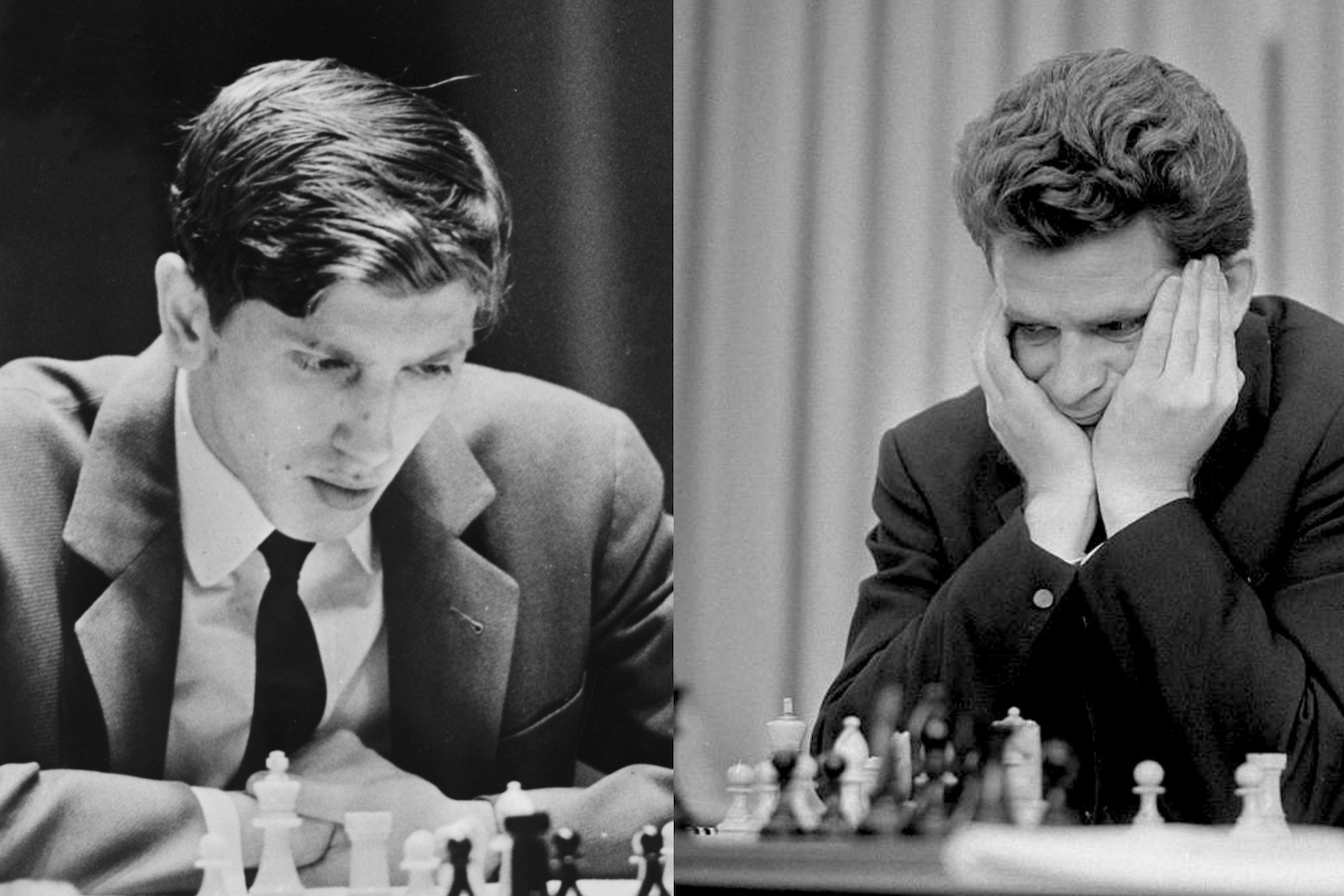
Bobby Fischer was a self-taught from Brooklyn of an unprecedented kind – an American who, against all odds, had fought his way through the Soviet-dominated chess world. Since 1948, Soviet players had won every single World Championship. Chess had become a Soviet science – systematized, state-funded, and cultivated as an ideology. Fischer was solitary, stubborn, and painfully direct. He demanded better prizes, better chairs, less noise, and no cameras.
Boris Spassky was most of what Fischer was not: well-mannered, cultured, pragmatic. He represented a superpower and a state model.
The world watched. Newspapers across the globe carried the games on their front pages. American authorities pressured Fischer to compete for geopolitical reasons. Henry Kissinger called personally.
Fischer won. The Cold War had found its battleground on 64 squares, and America won – with an eccentric, difficult, and brilliant man from Brooklyn.
The games from 1972 are still studied. Fischer-Spassky is more than a chess match. It is a cultural monument.

Chess tournament at the design bureau of Zavod No. 78, Moscow, April 22, 1935. The game was not reserved for the elite. It was actively promoted as mass culture in factories, clubs, and schools across the country. The Soviet state considered chess a sign of the intellectual strength of the socialist worker. The Russian chess machine, which would later dominate world championships for decades, was founded in these years.
Interlude: Chess in the Open Air
While world champions played under the lights in tournament halls and diplomats watched from government offices, chess also lived an entirely different life – out in the open, on stone tables in parks, with spectators standing close around the players in silence.
In New York's Washington Square Park, chess players have gathered since the early 20th century. In Budapest along the Danube. In Havana, in Berlin, in Moscow. And in Paris's Jardin du Luxembourg, where rows of green chairs and stone tables have stood since the 19th century, and where retirees, students, and tourists still meet over the 64 squares in the same light as always.

Chess in Osh, Kyrgyzstan – in the heart of Central Asia, a region that played an important role in chess's early history and in the cultural connections between India, Persia, and regions further west. Chess is played today on all continents, in all cultures, and in all languages.
Jardin du Luxembourg, Paris – a spring day at the chess tables under the blossoming trees. For all ages, without prizes and without titles.
It is this version of chess – popular and accessible – that perhaps best explains the game's survival. It requires no admission, no entry fee, and no invitation. A board and two players are enough.
9. Machine Beats Man: Deep Blue, 1997
May 11, 1997, in New York. Garry Kasparov – world champion and by many considered the greatest chess player in history – lost the sixth and decisive game to IBM's supercomputer Deep Blue.
It was the first time a computer defeated a reigning world champion in a match under tournament-like conditions. Deep Blue could evaluate about 200 million positions per second.

IBM RS/6000 SP - Deep Blue. The supercomputer that defeated Garry Kasparov in May 1997 and was the first machine to win a match against a reigning world champion under tournament-like conditions. Deep Blue is now exhibited at the Smithsonian Institution in Washington, D.C.
Kasparov was shaken. He asked for documentation of the machine's moves, suspected human interference, and never got his rematch. IBM decommissioned Deep Blue shortly after.
Today, a smartphone could beat Kasparov in a quick blitz game. But that's not the most interesting part. The interesting part is what 1997 came to mean culturally: It was the moment when humanity, in practice, had to abandon the notion that chess was the ultimate measure of intellectual superiority. The game did not lose its beauty. But it lost its absolute status as a test of the limits of human thought.
Kasparov himself made peace with it:
"The computer will not substitute for chess. Chess will exist after computers. The human element will always be the central part of chess." - Garry Kasparov
10. The Queen's Gambit and the Digital Comeback
In October 2020, amidst a global pandemic, Netflix released The Queen's Gambit – a miniseries about the fictional chess prodigy Beth Harmon, who fights her way from childhood trauma to the world elite in 1960s USA. The series was created with Kasparov as a consultant. Within days, searches for "chess set" and similar terms increased significantly on e-commerce platforms. Chess.com broke records. Replicas of the Lewis Chessmen sold out in the British Museum Shop.
It was hardly a coincidence that this happened during the pandemic. Millions of people were at home, looking for something to do with their hands, with their minds, with an opponent. Chess became an obvious answer.
Chess.com surpassed 100 million users by the end of 2022 and has continued to grow since. Magnus Carlsen – Norwegian, dominant for years and with a rating that has surpassed almost all previous peaks – was already bridging the gap between chess as a sport and chess as a culture: He played rapid chess with streaming stars, withdrew from the World Championship cycle in classical chess, and appeared in Louis Vuitton campaigns alongside Lionel Messi and Cristiano Ronaldo.
Chess is back. Bigger than it has been in a long time.
11. What a Physical Set Carries
It is easy to forget, in an age of digital chess platforms and AI-based analysis tools, that the game began with something physical. Ivory and walrus tusk. Cedar and ebony. Pieces of the world, shaped into symbols of human order and conflict.
The best chess sets are still made by hand. Turned from solid wood, balanced with metal weights in the base, covered with felt that muffles the sound of each move. There is something about touching a good chess piece – the weight, the surface, the soft click against the board – that connects us to a practice that is 1,500 years old.
Benjamin Franklin played with the pieces in hand at Café de la Régence. Medieval monks carved chessboards into the monastery's stone window sills. Fischer sat for hours staring at the board in Reykjavik.
It's the same game.
Sources and further reading
Historical works and modern research:
- Murray, H.J.R. A History of Chess. Oxford University Press, 1913.
- Hooper, David & Whyld, Kenneth. The Oxford Companion to Chess. Oxford University Press, 1992.
- Eales, Richard. Chess: The History of a Game. Batsford, 1985.
- Franklin, Benjamin. The Morals of Chess. 1779. Available via U.S. National Archives (Founders Online).
- Cazaux, Jean-Louis & Knowlton, Rick. A World of Chess: Its Development and Variations through Centuries and Civilizations. McFarland, 2017.
Literature and culture:
- Zweig, Stefan. Schachnovelle. 1941. (In Danish: Skaknovellen.)
- Nabokov, Vladimir. The Defense (Zashchita Luzhina). 1930.
- Diderot, Denis. Le Neveu de Rameau. ca. 1761–1774.
Modern and digital:
- Doggers, Peter. The Chess Revolution. 2024.
- Britannica: Chess — History (britannica.com)
- Wikipedia: History of chess, Chaturanga, Shatranj, Lewis chessmen, Deep Blue versus Garry Kasparov
- British Museum: The Queen's Gambit: How the Lewis Chessmen Won the World Over
- IBM: Deep Blue (ibm.com/history/deep-blue)
- CNN: The Queen's Gambit — Hit Netflix Show Will Speed Up Chess 'Boom' (2020)
- Burton, Howard. The History of Chess: A 1500-Year-Old Strategy Game. World History Encyclopedia, 2025.
Image sources (Wikimedia Commons, public domain):
- Samarkand pieces, approx. 760 CE: Chessmen from Samarkand — Wikimedia Commons
- Qajar courtiers, 1893: Golestan Palace Album No. 108-7 — Golestan Palace Library / Wikimedia Commons
- The Lewis Chessmen: Lewis Chessmen, National Museum of Scotland — Kim Traynor / Wikimedia Commons (CC BY-SA 3.0)
- Medieval illumination: British Library digitised image from "A History of Domestic Manners and Sentiments in England during the Middle Ages" — Wikimedia Commons
- Liberale da Verona: The Chess Players, approx. 1475 — Metropolitan Museum of Art (accession 43.98.8) / Wikimedia Commons
- Thomas Eakins: The Chess Players, 1876 — Metropolitan Museum of Art (accession 81.14), CC0 / Wikimedia Commons
- Moscow factory tournament, 1935: History of chess in Moscow 05 — P. Markovsky / Главархив Москвы / Wikimedia Commons
- Kyrgyz men, Osh: Kyrgyz men playing chess in Osh — Wikimedia Commons
- Luxembourg Gardens: Paris — Playing chess at the Jardins du Luxembourg (2955) — Wikimedia Commons
- Deep Blue: IBM RS/6000 SP — Deep Blue — Wikimedia Commons
See also: