How to Choose a Chess Set: A Complete Buying Guide
There's a moment many people know. You're sitting at a chessboard – maybe at someone's home, maybe in a café – and there's something about it. The pieces have weight. The board has depth. Everything about it feels considered. And you think: I want that at home.
But what exactly are you looking for? And what should you actually look for when choosing?
It's not a simple decision. Chess sets come in all sizes, materials, and price ranges – from cardboard boxes with plastic pieces to handcrafted sets in solid walnut that last for generations. This guide will help you navigate it.
What will you use the set for?
The first question is simple but important: what is the set for?
Will it be used for tournament play? For casual games with the family in the living room? As a gift? As a design object that can also be played on? Or to take on a trip?
The answer to that question changes your priorities. A serious chess player looks for standardized dimensions and a good feel in the hand. An interior stylist looks for aesthetics and material quality. A parent might be looking for something durable enough for children to carry around.
Most people fall somewhere in between. They want a set they can play on, and that also looks good. This is actually the easiest to find, because these two requirements largely point in the same direction: quality.
Board or set – what do you need?
Many overlook this question, but it's fundamental: do you need a complete set (board + pieces), just a board, or just pieces?
If you already have pieces you like, you don't need to buy a complete set. A good solid wood board can significantly elevate an existing set. Conversely, good pieces can shine on a board you already have.
However, few people start there. Most begin with a complete set – and that's also where the best experience comes from, as the board and pieces are designed to work together.
Size: it's all about proportions
Chessboards and pieces are not standardized for everyday use, but there's a practice that has proven effective. And it's a good idea to stick to it.
In tournament chess, the squares are typically 5.7–6.0 cm wide, and the king's height is around 9.5 cm. This creates a board that's easy to read both visually and by touch, where the pieces have room to stand without appearing cramped or lost in too large a square.
A rule of thumb: the piece should occupy about 75–80% of the square. If it fills more, the game feels compressed. If it fills much less, the pieces feel lost.
If you have limited space – or want to take the set with you – a foldable set of approximately 30 × 30 cm is an excellent alternative. It can fit in a bag or a drawer but opens up to a fully functional board. Norwald's foldable chess set in 30 × 30 cm is magnetic, so the pieces stay put. And it's made of solid wood, so it's no compromise.

Materials: why wood makes a difference
There's nothing wrong with playing chess on a cheap plastic set. But there's a reason why the best sets are made of solid wood, and why most people who have tried it once won't go back.
Wood has a warmth and texture that no synthetic surface can replicate. It feels different in your hands. It's a living material — no two sets are quite alike, no two pieces identical. And it ages beautifully, instead of yellowing and scratching.
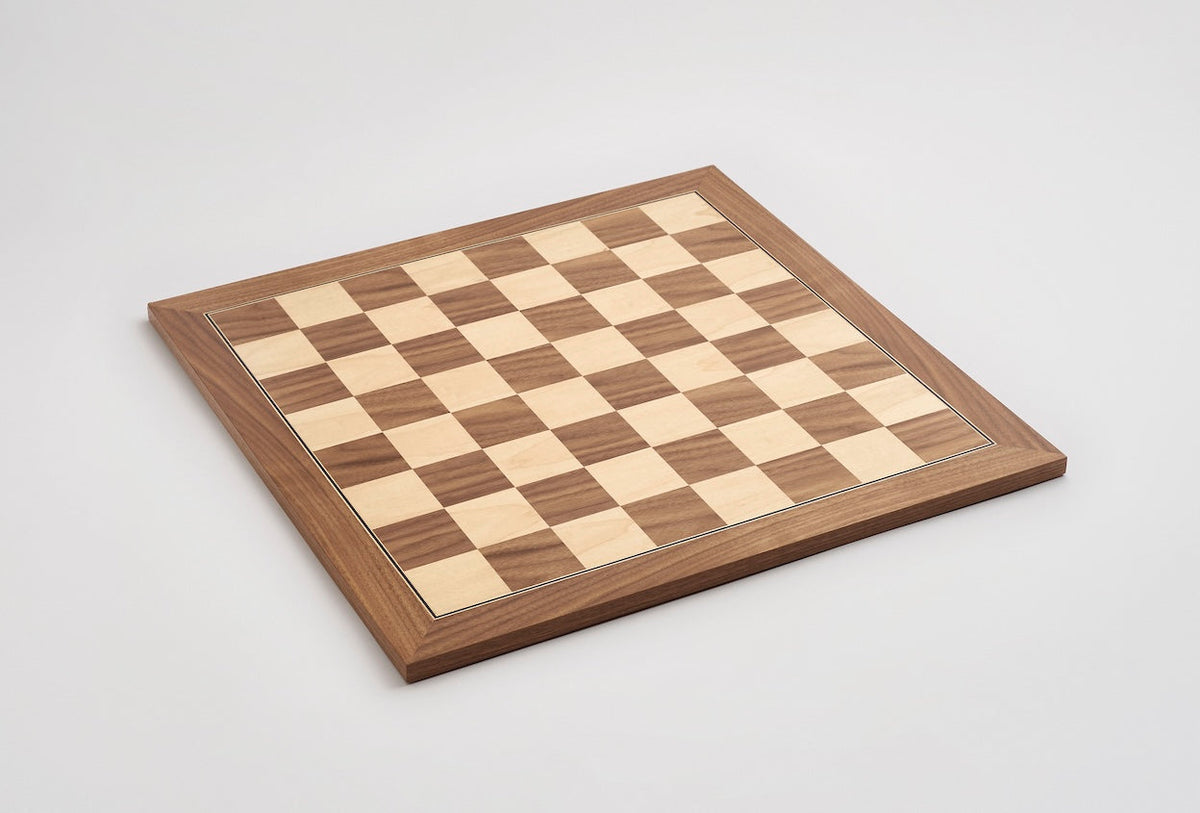
As for the board, the two most classic and widely used wood types are walnut and maple. Together they provide the typical contrast: dark and light. Walnut is a heavy, dense wood with a natural, deep brown color and prominent grain. Maple is lighter, more uniform, and offers a warm, creamy tone. For pieces, boxwood is often used for the light ones and rosewood or ebony for the dark – both are hard, dense, and durable. Read more about what makes walnut and maple ideal wood types for chessboards.
Veneer is cheaper than solid wood and can look nice. But it's superficial – in the most literal sense of the word. It wears out faster, and it lacks the depth of the material. A solid wood board can be sanded down, refinished, and last for generations. A veneer board rarely can.
Pieces: what you touch most often
The pieces are the set. The board is the backdrop – important and beautiful – but it's the pieces you touch, lift, and place. They're your connection to the game.
There are several things to look for:
Design. Most sets follow the Staunton standard, named after the English chess player Howard Staunton and introduced in 1849. It's the design almost all tournaments use, and it's recognizable and functional. Within the Staunton standard, there is variation – in the design of the knight (English vs. German style), in the rook's profile, in the detail of the king's crown. These differences are subtle, but they give each set its own character. Read more about the Staunton chess set and its history.
Weight. Good chess pieces are weighted – they have a small metal insert, typically steel or lead, placed in the base. This lowers the center of gravity, so the piece sits solidly and is difficult to knock over. The effect is clearly felt in the hand: the piece feels substantial at the base, not top-heavy. This is the feeling most people remember from a good set – and exactly what's missing when you try a cheap set afterward.
Felt. The underside of the pieces has felt, and this matters more than most people think. It dampens sound, protects the board from scratches, and gives the piece a soft, precise movement. The felt should be firmly attached, not shrink or fall off. It should be uniform in thickness so the piece doesn't tip.
Uniformity. A good set is handmade, but that doesn't mean there should be significant variation in the height or shape of the pieces. The variation is subtle – a slight difference in grain, a unique color gradient from piece to piece – not visible inconsistencies. If you hold a group of the same piece up, they should look very similar.

Piece size: what fits what?
Pieces are sold in sizes based on the king's height. The most common are:
- 75 mm: Suitable for smaller boards and travel sets
- 85–90 mm: Standard for home use and informal play
- 95–97 mm: Tournament size, wide and stable
Norwald's pieces are 95 mm and fit the 55 × 55 cm board, which is the most common format for home use and lighter tournament play. See the chess pieces here and the complete chess set here.
Price: what do you get for your money?
There are chess sets in all price ranges. What's the difference?
At the lower end, you'll find sets made of plastic or cheap pressed wood with simple pieces. They can be played on, but they rarely last many years, and the experience reflects that.
In the mid-range – roughly €50 to €150 – you'll find a mix: sets with solid boards and simple pieces, sets with veneer boards and decent pieces, and the occasional set that's well considered throughout.
In the upper range – and here we're still not talking about exorbitant prices – you'll find sets crafted with thought behind every element: wood types chosen for contrast and durability, handmade pieces, and correctly applied felt. These are sets that can be displayed for years and still look good.
A handmade solid wood chess set is not cheap – but it's not expensive either, considering its lifespan. A set that lasts 20–30 years and is used regularly is a better investment than three cheap sets over the same period.
Storage and maintenance
A good chess set doesn't require much. But it does require a little attention.
Solid wood reacts to humidity and dryness. It should not be exposed to direct sunlight for extended periods, nor should it be stored in places with significant temperature fluctuations – such as a garage or an unheated outbuilding. Indoors, in normal living conditions, there are rarely problems.
The pieces should be wiped with a soft cloth if they get dirty. Do not use water directly, and avoid strong cleaning agents. The board can occasionally be treated with a thin layer of furniture oil or beeswax paste, which keeps the surface moisture-balanced and enhances the wood's natural color.
Read our full guide on how to care for your solid wood chess set.
A set for the living room – or just for playing?
It's not an either-or.
A solid wood chess set can easily be displayed in the living room without looking out of place. It's an object with a calmness about it. It doesn't signal busyness or noise – it's quiet and familiar, an invitation to slow down. Many choose to leave it set up, as a kind of open invitation.
But of course, it's best when it's used. And that's precisely the advantage of a quality set: you want to touch it. It's not decoration collecting dust. It's something you actually use.
If you're in doubt about what a chess set can add to your home, you can read more about 18 reasons to have a chess set in your living room.

What should you choose?
Finally: what's the recommendation?
If you're looking for a set for your home – for playing, for display, for lasting many years – the recommendation is clear: solid wood, Staunton design, tournament size. Not because it's the only right choice, but because it's the most proven.
Norwald's complete chess set in 55 × 55 cm is made of solid walnut and maple, with handcrafted 95 mm Staunton pieces. It's designed for home use – to look good and built to last. If you want something you can take with you, the foldable set in 30 × 30 cm is a natural choice.
Whatever you choose: a good chess set is an investment in something that lasts. And you feel it every time you move a piece.